If you want a crochet blanket that can be casually folded, draped or used either way up, check both faces of a finished sample before starting the full blanket. Include a color change and the finishing details you plan to use. A body stitch you like on both sides is only one part of the decision.
Decide what reversible means to you
You might want nearly the same appearance on each face, or two different appearances that you enjoy equally. Write down which matters before choosing a pattern. A listing described as reversible is a useful starting point, but look for photographs of both faces and instructions that match your experience.
For example, the Hudson Blanket listing at Lion Brand explicitly describes its design as reversible and made in one piece with a border. That is a description of that particular design, not evidence that every striped blanket has the same result. We have not made or tested that pattern. Use the designer's instructions for construction; this article is a sample-review plan, not a stitch pattern.
Make a sample that includes the decisions
Follow enough complete repeats of your chosen pattern to see its texture clearly. If the blanket uses several colors, include a representative transition. If it uses squares or panels, make two small pieces and join them. Add a short section of the intended border, including a corner if the construction allows it, and finish the ends as you would in the blanket.
Mark the faces A and B in your notes. If the pattern identifies a right side, keep track of it even when you like both faces; the instructions may rely on that orientation. Prepare the sample according to the yarn and pattern care instructions before making your final comparison. Our before-and-after measurement guide helps keep that step consistent.
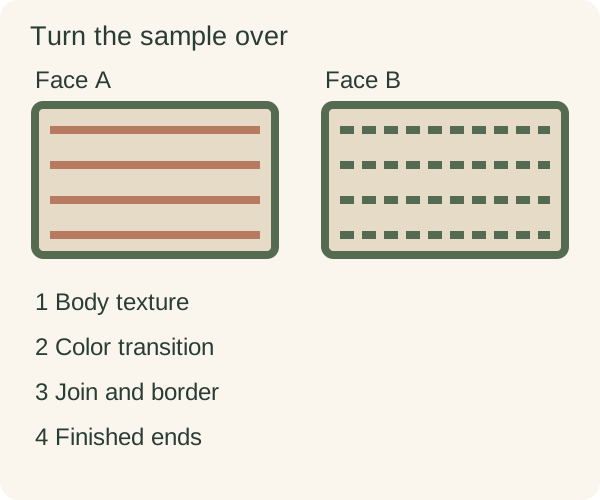
Review four parts on both faces
| Part | What to check |
|---|---|
| Body | Do you like the texture, openness and feel from either side? |
| Color transition | Are the lines and visible carried strands acceptable on both faces? |
| Join and border | Do raised edges or different textures feel intentional? |
| Ends | Are the finished areas tidy when the fabric is gently opened and turned? |
View it flat and with one edge folded back. The fold places both faces together, much as they may appear over a sofa arm. Compare in ordinary daylight as well as the light where you expect to use it. You do not need identical faces for a pleasing result; you need a result you are comfortable showing.
Let the join be part of the design
Lion Brand's seaming guidance notes that slip-stitch and single-crochet seams worked on the right side can create a decorative ridge. That ridge may be a feature you enjoy rather than a flaw to hide. Sample the actual join and turn it over before joining every square.
For a quieter outline, compare an alternative join permitted by the pattern on a second sample. Check its dimensions and feel as well as its appearance. Changing the assembly can affect your plan, so update your joining-yarn reserve and measurements if needed.
Change one detail before abandoning the palette
If the body looks lovely but one transition distracts you, try the same stitch in one color to see whether the issue is the color change rather than the texture. If the border dominates one face, compare a simpler edge on the sample. These are design experiments, not promises that a particular alteration will work with every pattern.
A moss-and-cream blanket can be interesting through texture alone; a clay accent might be saved for a border you like from either side. Keep any carried-yarn technique within the pattern's guidance, and review the end-finishing plan before repeating dozens of color changes.
Save the sample you chose
Photograph both faces and note the yarn, hook, orientation, join and border. Use that actual construction when estimating quantities; a different sample is not a reliable substitute. Keep the sample alongside the project so you can check later pieces against the decision you already made. For a gift, include the appropriate care information whether the two faces match or differ.
Keep planning your blanket
Examples illustrate the arithmetic; they are not physical project tests. Send a correction.