Measure the same crochet swatch before washing and again when it is fully dry, using a care method allowed by the yarn label. Keep width and length separate, record how you prepared the sample, and use the measurements that match your intended finished blanket. Do not assume every yarn changes by the same amount.
Make the sample represent your blanket
Use the intended yarn, hook and stitch. Include a color transition if you need to see how two yarns look together after care. The Craft Yarn Council recommends making a gauge swatch and comparing it with the pattern. Follow the pattern’s instructions about whether its gauge is measured before or after finishing.
Label the sample with the yarn names, colors, hook size in millimeters and stitch repeat. For mixed yarns, keep every label and establish a shared care method first; our leftover-yarn guide covers that decision.
Record a dry starting point
Lay the sample flat without stretching it. Measure its full width and length, then count stitches and rows over a clearly identified inner measurement window. Those are different records: the full rectangle is useful for area calculations, while the inner window avoids using an irregular edge as your only gauge reference.
Write down the window location so you can measure the same area again. Photograph the sample with a ruler if that helps you compare its outline later. Note texture, gaps and how the colors meet. If you are estimating yarn consumption, weigh the dry sample separately; a damp sample is not a useful substitute for dry yarn weight.
Follow the label, then measure fully dry
The Craft Yarn Council’s care-symbol reference explains washing and drying symbols. There is no single washing temperature, drying method or blocking treatment suitable for every blanket yarn. If washing is prohibited or the label is unknown, do not invent a wash procedure.
Record the permitted method you actually use, including whether you shaped or pinned the sample. Once fully dry and removed from any pins, lay it flat again without pulling. Measure width, length and the same stitch-and-row window. Record any color transfer or change in texture you observe; one sample is evidence about that trial, not a guarantee about all future care.
Calculate each direction separately
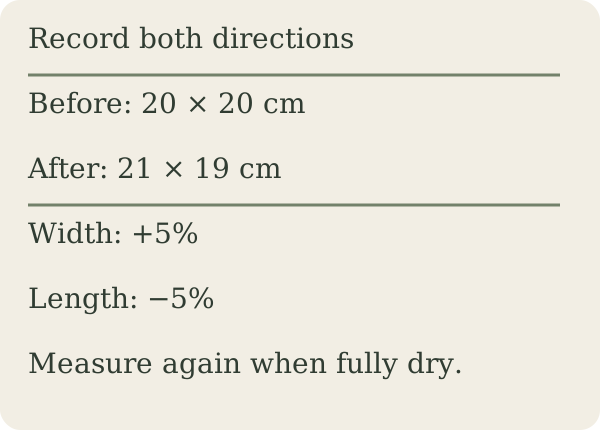
For an original arithmetic example, suppose the full sample starts at 20 × 20 cm and finishes at 21 × 19 cm. Width change is (21 − 20) ÷ 20 × 100 = +5%. Length change is (19 − 20) ÷ 20 × 100 = −5%. The area changes from 400 to 399 cm², so an almost unchanged area would hide the two different directional changes.
If that behavior were representative, a target of 100 × 120 cm after care would correspond to about 95.2 × 126.3 cm before care: divide 100 by 1.05 and 120 by 0.95. This is a planning projection, not an instruction to stretch a blanket or proof a full-size piece will behave identically.
Update the plan once, using consistent measurements
The simplest route is to use the fully prepared sample’s measured gauge for your intended finished dimensions. Adjust to complete stitch repeats and row repeats. Do not also apply the percentage adjustment to counts already calculated from the finished gauge.
For the yarn calculator below, use dry sample weight and the full sample dimensions in the same finished state as your target. Keep border requirements separate. Save the observations with your project notes and pass the yarn care information to the recipient if the blanket is a gift.
Use the calculator ↗Examples illustrate the arithmetic; they are not physical project tests. Send a correction.