Start a mixed-leftover blanket by sorting the yarn, not by adding all the grams together. Identify what you have, check compatible care instructions, and sample the yarns together before choosing the full layout. A basket of beautiful colors becomes a useful supply only when you know which yarns can share the project.
Make three small groups
Put clearly identified yarns with compatible care instructions in a candidate group. Keep uncertain yarns in a sample-first group, and set aside yarns whose care needs conflict with the blanket you want. These are planning groups, not guarantees of compatibility.
For each ball, record the yarn name if known, fiber information, color, net weight and original label length and weight. The label guide explains those entries. If the label is missing, mark the unknowns rather than assigning a fiber or length by appearance.
The Craft Yarn Council’s care-symbol reference explains label symbols and recommends passing yarn care information along with a handmade gift. For a mixed-yarn blanket, keep the information for every yarn. If you cannot establish a suitable shared care method, choose a different combination.
Choose an anchor color and roles for the rest
Lay the candidate yarns beside the place where the blanket will live, or choose a shade the recipient enjoys. A generous supply can become a repeated background; smaller amounts might become occasional accents. Our color palettes are starting points, not rules.
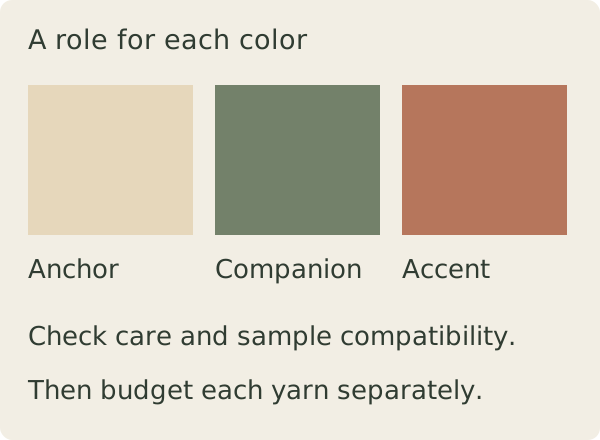
Equal grams of different yarns need not make equal areas of fabric. Do not assume that three similarly sized balls can make three equal color bands. Keep each yarn’s supply separate until you have measurements that support combining the estimates.
Sample the actual combination
Make representative samples in the stitch you intend to use, and include transitions between candidate yarns. For motifs, compare complete samples and try the intended join. Record dimensions, hook and the fabric you like. The Craft Yarn Council recommends checking a gauge swatch against the pattern; a label or hook recommendation alone does not establish the result.
Prepare the combined sample using a method permitted by all its known care instructions. Compare its dimensions and appearance before and afterward, and note unwanted color transfer or distortion if you observe it. A small trial gives you evidence about that combination, not a promise about every future wash. An unidentified yarn may be better saved for another project if its uncertainty prevents a workable care plan.
Budget the candidate group, not the whole basket
Here is a hypothetical inventory after sampling and selecting compatible yarns: 180 g cream, 90 g moss and 45 g clay. Reserving 30 g cream for finishing leaves 150 g, 90 g and 45 g for body planning. With a 10% allowance above base consumption, divide each by 1.10: about 136.4 g cream, 81.8 g moss and 40.9 g clay can be assigned to base estimates.
Those numbers are budgets, not interchangeable areas. Use each yarn’s own sample consumption to decide how many rows or motifs its budget supports. Round down to complete design units. Keep trial yarn separate unless it remains available or the trial will be included in the blanket.
Choose a layout that allows a change of plan
For stripes, use the color-by-color planning guide. For motifs, the square consumption guide helps budget each treatment. Avoid assigning a scarce accent to every outer round before checking the total it will need.
Use the calculator below for partial balls with known label ratios. A single stash-planner input is appropriate only when its sample represents the fabric and yarn mixture being estimated. Keep separate records when it does not. Write one fallback in your project notes, such as fewer accent bands or a smaller layout, so a shortage does not force an improvised decision at the very end.
Use the calculator ↗Examples illustrate the arithmetic; they are not physical project tests. Send a correction.