Estimate yarn per granny square by measuring the yarn consumed in a complete representative square, including the tails you intend to leave. Multiply that amount by the number of matching squares. For a multicolor design, measure each color separately: a total square weight cannot tell you which shade will run out first.
Choose a square worth repeating
Make the actual motif, with the planned yarn, hook, rounds and color order. A small unfinished center is not a consumption sample for the full square. Check its dimensions and appearance before using it to budget an entire blanket. The Craft Yarn Council’s gauge guidance supports sampling and comparing the result with the pattern.
Lay a few sample color arrangements together. Cream around each motif could give your layout a common frame, while alternating moss and clay centers could add variety. These are design choices, not a tested pattern. Use the square-count guide to settle the grid from measured dimensions, joins and the planned outer border.
Measure yarn consumed, not just the trimmed square
Weigh each source ball immediately before and after making the sample, excluding labels, cores and tools consistently. The difference captures yarn taken from that ball, including attached tails and any offcuts removed from the supply. Note whether trial scraps or other work also used yarn during the measurement; those would distort the result.
If one square uses too little for your scale to resolve reliably, measure several matching squares as a batch, then divide consumption by the number made. Do not combine unlike sizes or color arrangements into one average unless their proportions match the planned blanket.
Scale each color to the layout
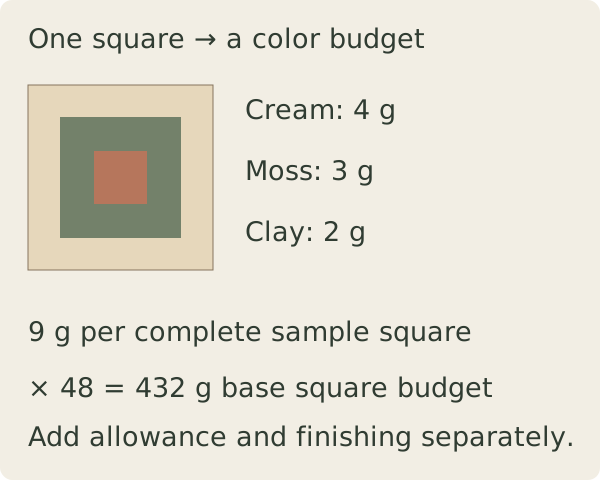
Suppose a sample consumes 4 g cream, 3 g moss and 2 g clay. For 48 matching squares, the base amounts are 192 g, 144 g and 96 g respectively: 432 g total. With an illustrative 10% allowance, the square budget becomes 475.2 g.
| Color | 48 squares | With 10% |
|---|---|---|
| Cream | 192 g | 211.2 g |
| Moss | 144 g | 158.4 g |
| Clay | 96 g | 105.6 g |
The allowance is your choice, separate from the sample consumption. Tails already captured in the sample should not be added again. If you are making 24 squares in one color order and 24 in another, measure both versions and multiply each by 24 before adding their color totals. Swapping an inner and outer color does not establish equal consumption.
Keep assembly outside the square budget
Add joining yarn and the outer border as separate lines. If the last motif round also joins it to a neighbor, record that yarn once rather than assigning the same round to both budgets.
For example, adding a separately estimated 40 g cream finishing reserve to 211.2 g gives 251.2 g cream. At 50 g per package, that rounds to six cream packages. Moss rounds to four and clay to three: 13 packages total. These reserves and package sizes are hypothetical; rounding the combined weight to packages would conceal shortages in individual colors.
Check the supply as your pile grows
Lion Brand explains why label length matters when comparing yarn packages. Use each yarn’s own label to convert grams to length; do not apply one shade’s ratio to a different yarn. The calculator below can estimate the length remaining in partial balls.
After a batch, compare actual consumption with your sample and update the remaining-square budget. If the sample square will be part of the blanket, count it among the 48: do not budget 48 additional squares and then also include the sample. Keep the color totals and number still needed on your project sheet.
Use the calculator ↗Examples illustrate the arithmetic; they are not physical project tests. Send a correction.