Estimate joining yarn from the join you actually plan to use: measure yarn consumed by a representative seam, then scale it to the number of comparable seams in your blanket. Keep this reserve separate from yarn for the squares and the outer border.
Choose how the join should look
Do you want the squares to read as separate framed pieces, or would you prefer the join to blend into their edges? Put two samples side by side with your possible joining colors. Try the intended method before reserving yarn; a color sketch cannot show the finished seam’s texture.
Lion Brand’s invisible-seaming tutorial shows one sewn assembly method. Use your pattern or a suitable tutorial for the actual technique. Our estimate does not assume that a sewn seam, a crocheted ridge and a joining band consume the same yarn.
Count shared edges once
For a rectangle of C columns and R rows, the number of square-edge seams is (C − 1) × R + (R − 1) × C. Count each shared boundary once, even though it connects two square edges.
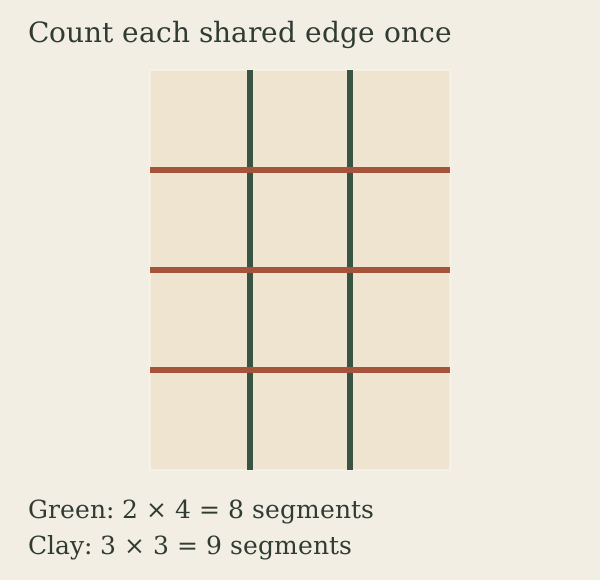
In the six-by-eight blanket layout, the count is 5 × 8 + 7 × 6 = 82 seams. These are individual square-edge segments, not necessarily 82 separate lengths of cut yarn. A continuous joining method may cross several segments before you finish the yarn.
Measure a useful sample
Weigh your joining yarn before and after working several representative segments, excluding labels and tools from both measurements. Record how many segments you worked and whether your measurement includes tails, corners or intersections. A larger sample helps when one short seam uses too little yarn for the scale to resolve.
Use the same yarn, joining technique and square-edge length as the blanket. If the finished squares differ in size, estimate each seam length or class of seam separately. Do not average unlike segments without accounting for their differences.
A worked reserve, from sample to package
Suppose four equivalent segments consume 6 g of yarn for the seam stitching alone. That gives 6 ÷ 4 = 1.5 g per segment. For 82 segments, the base seam estimate is 123 g. An illustrative 10% allowance gives 135.3 g.
| Planning step | Example |
|---|---|
| Sample rate | 6 g ÷ 4 = 1.5 g per segment |
| Base seam yarn | 82 × 1.5 = 123 g |
| With 10% allowance | 135.3 g |
| Separate measured/planned finishing reserve | 10 g |
| Total joining budget | 145.3 g |
The 10 g finishing reserve and 10% allowance are example inputs, not universal recommendations. At 50 g per package, this budget rounds to three packages, or 150 g. If the sample already includes representative tails, do not add the same tails again. If intersections use a different construction, sample those separately.
Know when this model does not fit
For join-as-you-go construction, a round may both finish a motif and connect it to its neighbors. Count its yarn once, under either the square budget or the assembly budget. If your method travels around exposed edges as well as shared seams, the shared-edge count alone misses part of the work. Map the actual path or follow the pattern’s quantity guidance.
Keep yarn for the outer border separate too. Check the length left in partial balls with the calculator below, then add the joining method, sample rate and reserve to your project notes. These are measurement-based estimates; no finished blanket has been tested for this example.
Use the calculator ↗Examples illustrate the arithmetic; they are not physical project tests. Send a correction.