Before putting away an unfinished crochet blanket, secure the working loop, write down the exact next step and keep the yarn labels with the project. A note saying “row 24” is less useful than “row 24 finished; next is row 25 in moss; turning chain not worked yet.” The aim is to leave yourself a clear starting point, whether you return tomorrow or after a longer break.
Secure the loop before removing the hook
For ordinary crochet with one working loop, place a locking stitch marker through that loop when you remove the hook, then close the marker. PlanetJune's stitch-marker tutorial demonstrates holding the working loop between sessions and putting it back on the hook to resume. The loop holder serves a different purpose from a marker identifying a stitch or the start of a round.
Write down which marker does what if you use several. Do not remove the pattern's position markers just because you have secured the working loop. This method does not cover Tunisian crochet or other work with multiple live loops; use instructions appropriate to that construction.
Leave a restart note, not just a row number
Use this short checklist on a paper card or in your project notes. Record what actually happened rather than what you planned to finish.
- Pattern: name, source, version or page, and US or UK terminology.
- Last completed work: row or round number, color and repeat position.
- Next action: turn, chain, change color or continue a named repeat, following the pattern.
- Hook: millimeter size and which hook you used, if you own several in that size.
- Checks: last verified stitch count and what each marker means.
- Outstanding work: loose ends, incomplete joins or a section you intended to check.
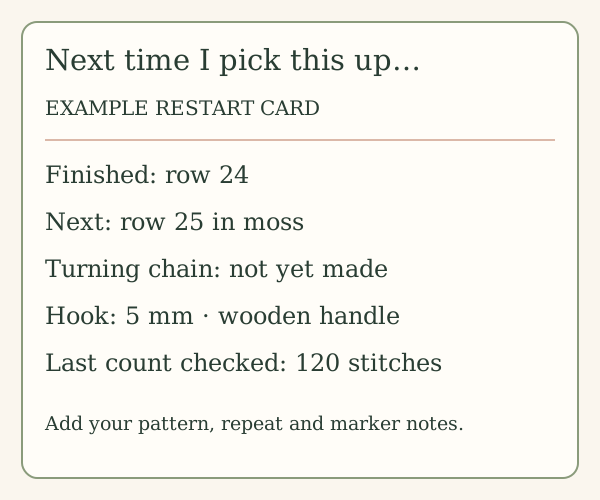
If you must stop mid-row, describe the location in the repeat as well as the number of stitches worked. Take a close-up showing the working edge and markers. A photograph can support your note, but may not reveal whether you already made a turning chain or completed a partial stitch.
Keep the blanket, pieces and supplies together
Choose a clean storage space where the project will stay dry and away from direct sunlight. The WEBS yarn-storage guide discusses dry, protected storage for yarn. Do not pack away damp fabric or assume a project bag is suitable for every fiber and storage environment. Check your yarn's care guidance if the work needs cleaning before storage.
For practical organization, put the yarn labels and restart card in a separate pocket or envelope. Keep loose needles and scissors in their own case. Support the blanket rather than letting its weight hang from the working yarn. Store the working ball with the blanket so moving one does not pull against the other.
For separate squares, record how many are complete and how many are still missing rounds or ends. If you already arranged them, photograph the layout and label stacks by row. Use the square-color layout guide for the arrangement itself; this step preserves your chosen arrangement while it is packed away.
Keep reserved yarn from becoming accidental leftovers
Label supplies by their intended job: body, joining, border or unassigned. For example, six completed squares plus three unfinished squares is not nine finished squares. Likewise, a 40 g ball reserved for the border is not spare yarn for another project. These are inventory examples, not suggested quantities.
Keep shade names and dye lots with the actual balls. If you record remaining weight, note the date and whether it excludes packaging. Our partial-skein guide explains the measurement; the project sheet holds the broader design plan.
Use the first few minutes back to check your place
Read the note alongside the pattern, inspect the last completed section and confirm the hook and color. Restore the working loop to the hook and check the markers before proceeding. If the note and fabric disagree, find the last point you can verify rather than guessing a new row number.
After a short section, lay the work down and compare it with the earlier fabric. If the width looks different, use the stitch-count and gauge checks before continuing. Update the restart note at the next pause. A small, current record is more useful than a detailed plan that no longer matches the blanket.
Keep planning your blanket
Examples illustrate the arithmetic; they are not physical project tests. Send a correction.