Before starting a crochet blanket, check whether the pattern uses US or UK stitch names. The abbreviation dc is particularly easy to misread: UK double crochet is US single crochet, while US double crochet is UK treble crochet. Translating the name preserves the intended stitch; using your familiar meaning without checking can change the fabric you make.
Find the pattern's terminology statement
Look near the introduction, abbreviations or pattern notes for an explicit US or UK statement. For a book or magazine, check its general reference pages too. Do this separately for any border tutorial you plan to add; two sources can use different conventions.
If the system is unstated, look for definitions or a demonstration supplied with the pattern. Treat the designer's location, spelling and a finished-blanket photo as insufficient evidence on their own. If the instructions remain ambiguous, ask the publisher or choose a clearly explained alternative before committing your yarn.
A quick US–UK stitch-name chart
These common equivalents follow the Craft Yarn Council abbreviation reference. Its guidance also notes that designers may define special abbreviations in the pattern. Read those definitions rather than assuming a familiar-looking abbreviation always has its usual meaning.
| US name | UK equivalent |
|---|---|
| Single crochet (sc) | Double crochet (dc) |
| Half double crochet (hdc) | Half treble (htr) |
| Double crochet (dc) | Treble (tr) |
| Treble (tr) | Double treble (dtr) |
| Double treble (dtr) | Triple treble (trtr) |
| Slip stitch (sl st) | Slip stitch (ss) |
The same reference pairs “gauge” with “tension.” When a pattern gives stitches and rows over a measured area under that heading, record both numbers with their units on your project notes.
Keep the body and border in separate columns
Imagine you have chosen a blanket body written in US terms and a border tutorial written in UK terms. If the body calls for US dc and the border calls for UK dc, those instructions require different stitches. Writing “double crochet throughout” on a project card would lose that distinction.
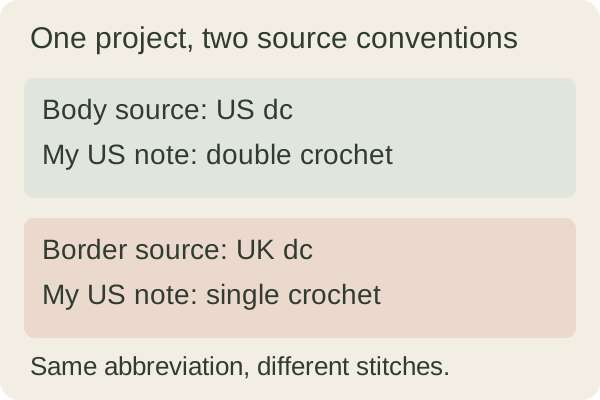
Choose one terminology system for your own notes and label it. In this example, a US-terms note would say “body: dc; border: sc.” Keep the original instructions beside the note so you can still check placement, corners and repeats.
Translate names without rewriting the construction
A name conversion does not tell you to add stitches, change a turning chain or alter the repeat count. Retain the pattern's numbers and placement instructions. For special stitches, use its full definition rather than replacing fragments of an abbreviation automatically.
The Craft Yarn Council's pattern-reading guide explains repeats and turning-chain conventions, including following a pattern's exceptions. If a row count looks wrong after translation, check those instructions before deciding the design needs resizing. Our blanket-width troubleshooting guide covers count and edge-placement checks.
Confirm the sample before estimating yarn
Make the pattern's sample using the intended stitch, then record the terminology, yarn, hook and measurements together. If you discover that an earlier sample used a different stitch, do not reuse its yarn estimate as though nothing changed. Make the intended sample and update the plan.
Use the project planning sheet to keep the source links and your terminology note together. Once the sample is representative, the weighed-swatch method and calculator below can help budget body yarn. Estimate a separately worked border on its own; a terminology chart cannot predict its yarn consumption.
Keep planning your blanket
Examples illustrate the arithmetic; they are not physical project tests. Send a correction.