Estimate blanket completion time from your own pace on representative work: remaining rows or motifs multiplied by time per unit, plus separate finishing tasks. Then compare that workload with the sessions you realistically have available. There is no single number of hours that fits every blanket or maker.
Choose a useful unit to time
For a rectangular blanket with consistent rows, time several complete rows at the actual width. For a repeated motif layout, time complete motifs. A narrow practice swatch does not take the same time as a full-width row, and an early center-out round does not represent a much larger later round.
For a changing stitch sequence, time a complete repeat or track each section separately. Check which rows repeat in the pattern; the Craft Yarn Council’s pattern-reading guide explains repeat notation. Use the row-length guide to establish the remaining row count before estimating its duration.
Record a few ordinary sessions
Note units completed and active minutes, including routine turning and color changes if those belong to the unit. Exclude a long interruption from active time, but account for interruptions when choosing your available sessions. Record whether you included ends or checking the pattern so you do not count the same work twice.
For an original arithmetic example, suppose three sessions each complete four comparable rows in 36, 44 and 40 minutes. That is 120 minutes for 12 rows, averaging 10 minutes per row. These are hypothetical observations, not a test of a named pattern or a claim about your speed.
Make a range for the remaining work
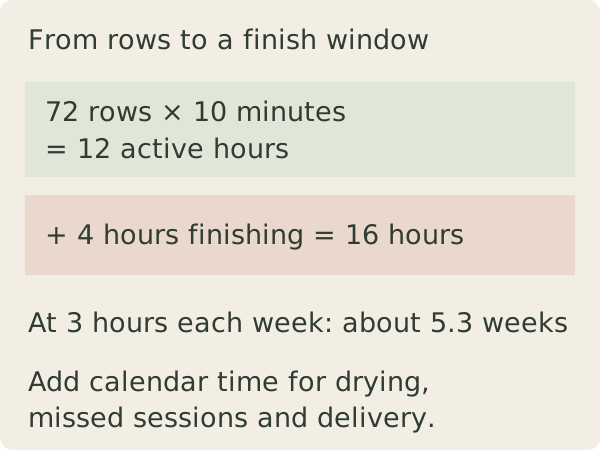
With 72 equivalent rows left, that average suggests 720 minutes, or 12 active hours. The example sessions range from 9 to 11 minutes per row, giving 10.8 to 13.2 hours for those rows. Treat this as a planning range based on three sessions, not a statistical confidence interval or guaranteed finish time.
Give finishing its own lines
List the tasks still to do: joining, weaving ends, border, any permitted washing or preparation, drying, and wrapping or delivery if it is a gift. Estimate active tasks from a representative seam, batch of ends or border section where possible. Drying and delivery are elapsed time, not active crochet time, and should be scheduled separately.
If you have already woven ends during the timed rows, include only the remaining ends here. For motifs, check the joining guide to understand the assembly scope. The Craft Yarn Council’s care reference helps interpret the labels for preparation; it does not provide a universal drying duration.
Turn hours into a realistic date window
Suppose the 12-hour body estimate needs another four active hours of finishing: 16 hours total. Four 45-minute sessions per week provide three active hours weekly, so the average estimate is 16 ÷ 3 = about 5.3 weeks. Using the body range above and the same four finishing hours gives roughly 4.9 to 5.7 weeks, before extra calendar time for drying, missed sessions or delivery.
If your gift date is five weeks away, this example does not comfortably fit: five weeks provide 15 active hours at the planned pace. Consider a smaller project, a simpler finish that suits the design, or a later gift date. Do not turn a creative project into a promise based on your fastest session.
Update the forecast as you go
At a complete repeat or motif batch, subtract what is finished and recalculate from recent comparable sessions. A new stitch, wider section or more complex color sequence deserves a new timing sample. Keep the estimate beside your yarn budget on the project sheet.
If you choose a smaller blanket, the stash planner below can help explore dimensions from available yarn; it does not predict working speed. Recheck the pattern and count the revised work separately before changing your schedule.
Use the calculator ↗Examples illustrate the arithmetic; they are not physical project tests. Send a correction.