Before starting a temperature blanket with one row for each day, multiply the number of days by your measured row height. Add any separator rows and the top and bottom borders. This simple check can tell you whether your year-long record will become the throw you imagined or a much longer blanket.
A temperature blanket assigns a yarn color to each recorded temperature range. You can record a new year as it happens or use a past year's observations for a meaningful gift. The calendar determines how much data you want to include; it does not automatically determine a convenient blanket size.
Decide what one day means in your design
Write down the location, weather source, temperature unit and measurement you will use, such as the daily high. Keep that rule consistent. Also decide whether one day is one row, a section of a row or a motif. The calculations here are for a rectangular blanket with one full row per day and comparable row heights.
Lion Brand's Crochet Temperature Blanket is an example of a daily-high, one-row-per-day design. Its notes explicitly flag the generous length and explain that local temperatures affect how much of each color is needed. Its quantities belong to that pattern and yarn, not to every temperature blanket.
Measure row height before committing to the year
Make a sample using your intended yarn, hook and stitch. Prepare and measure it in a state comparable to the finished blanket, following its care instructions. Measure several complete rows together and divide the height by the row count. Do not judge row height from one stitch alone.
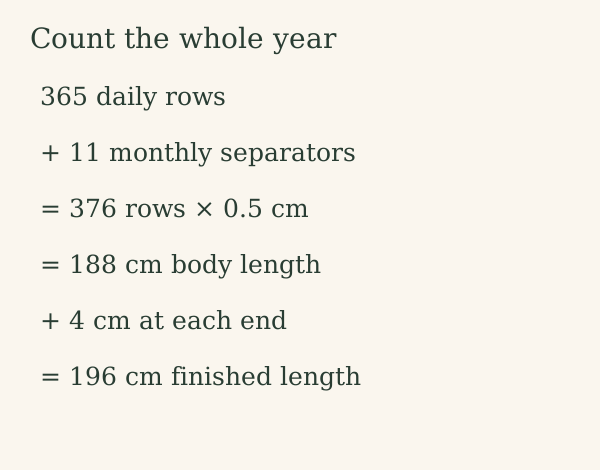
For example, if 20 rows measure 10 cm, each row averages 0.5 cm. For a 365-day year, the daily rows would measure approximately 182.5 cm. Eleven one-row separators between months bring the body to 376 rows, or 188 cm. A 4 cm border at each end brings the estimated total length to 196 cm. These are original planning numbers, not a tested blanket.
For a leap year, use 366 daily rows. In the same example, that adds 0.5 cm. If your pattern adds setup or final rows that do not represent days, count those separately too. Do not count the first day's row twice just because it is also called a setup row.
Work backward from your preferred length
Suppose you want a 160 cm total length with two 4 cm end borders. That leaves 152 cm for the body. With 365 daily rows and 11 separator rows, the average row height would need to be 152 ÷ 376, approximately 0.404 cm, equivalent to about 24.7 rows per 10 cm.
This is a target to compare with a sample, not a guarantee that a particular hook or stitch will achieve it. If your sample makes a longer blanket than you want, consider a different sampled construction, fewer separator rows, a shorter recording period or a motif-based design. Each changes the plan; reducing width alone does not shorten 365 rows. Use our blanket-size guide to choose intended coverage first.
Build a color key without assuming equal yarn use
Choose colors you enjoy together, then assign non-overlapping temperature ranges with no gaps. Write the unit beside the key. For decimal readings, state whether you round first or use exact boundaries, such as 10°C up to but not including 15°C. Add categories covering readings outside your expected range.
For a past year, count the days in each color category before budgeting. If 80 days fall in one range and 15 in another, those colors represent 80 and 15 daily rows respectively. A future year's distribution is unknown; historical observations can inform a provisional plan but cannot guarantee it. Keep border and separator yarn separate from daily colors, and use the per-color stripe budgeting method with your own representative measurements.
Keep the record manageable
A small log with date, recorded temperature, assigned color and completion status lets you separate recording the weather from finding time to crochet. Missing a crochet session does not require inventing the temperature: consult your chosen source's historical observations. If a value is unavailable, mark it missing and decide how to represent it rather than silently substituting another measurement.
Keep that log with your project plan. Before buying the full supply, confirm your size calculation, color key, yarn compatibility and finishing reserve. You will then have a design you can explain as well as a blanket you can use.
Keep planning your blanket
Examples illustrate the arithmetic; they are not physical project tests. Send a correction.