Choose solid yarn when you want to place each color change yourself. Consider variegated yarn when you enjoy several colors appearing along one strand and are comfortable checking the resulting fabric before committing. Neither choice is automatically better for a blanket: the important question is whether you like the yarn worked in your stitch and at your intended width.
Start with the kind of color control you want
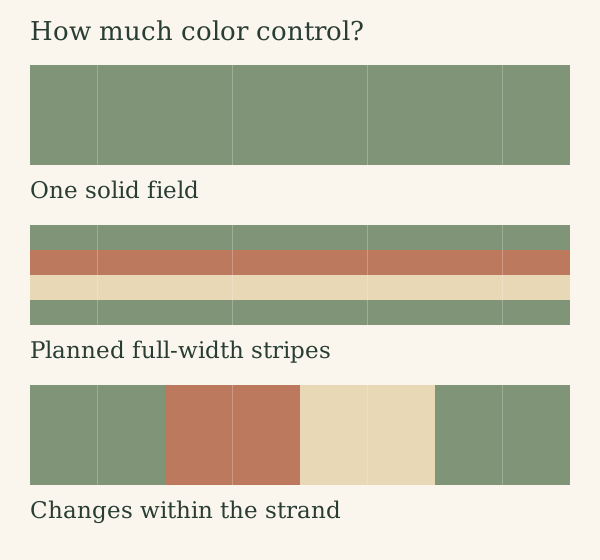
A solid shade gives you a straightforward background for evaluating stitch texture. You can combine several solids into stripes or motifs with deliberate boundaries. Variegated yarn contains color changes within the strand; their placement in the blanket depends on how that strand becomes stitches and rows.
| If you want… | Try this first |
|---|---|
| Specific colors starting at specific rows | Separate solid shades and a written stripe plan |
| Color changes within the fabric without selecting each change yourself | A variegated yarn sample |
| A quiet frame around a colorful body | A solid border candidate beside the finished sample |
| A deliberate pooled geometric effect | A planned-pooling tutorial and suitable repeating yarn |
These are starting suggestions, not rules about what you should like. For a gift, consider the recipient's actual color preferences. A bold multicolor blanket and a single-color textured blanket can both be thoughtful choices.
Do not read the finished layout from the ball alone
The same colors can feel different when they form tiny marks, longer runs or larger patches. Product labels may describe yarn as variegated, self-striping or gradient; inspect the maker's worked examples and the strand rather than assuming those words tell you the exact length of each color section.
A photograph of a narrow scarf in a yarn is not a reliable preview of a much wider blanket. Before relying on a particular stripe or pooling effect, check a sample that represents your intended stitch count and construction. A small square can help shortlist yarns, but may not reveal the color placement of a full-width row.
Separate natural color patches from planned pooling
Yarnspirations' color-pooling guide explains that its planned effect needs an appropriate repeating color sequence and experimentation with hook size, tension and starting-chain length. A multicolor label alone does not promise an argyle or other organized pattern.
If you like the unexpected patches in your sample, you do not have to change them. If you want a precise geometric result, treat planned pooling as its own technique and follow a suitable tutorial. Do not keep altering tension merely to force colors into place if the resulting blanket fabric is uncomfortable or inconsistent.
Compare two samples using the same questions
Work the intended stitch with each candidate, following any gauge requirements in your chosen pattern. Label the samples with yarn, shade, hook and stitch count. Where practical, compare compatible yarns so a change of fiber or thickness does not get mistaken for a color effect.
- Can you see the texture you wanted from normal viewing distance?
- Can you identify stitch tops and row ends comfortably while working?
- Do you like the color distribution at the planned width?
- Does the fabric feel appropriate for how you will use the blanket?
- Are the yarn's care instructions suitable for the person receiving it?
If a colorful sample makes the texture difficult for you to see, try a solid shade, a quieter color range or another sampled stitch. Those are alternatives to compare, not a universal claim that textured stitches cannot work with variegated yarn. Keep the samples beside each other in the same light. Our contrast guide helps with separate adjacent shades.
Budget the yarn you actually choose
Count yarn length and measured consumption, not the number of colors visible in a ball. A multicolor yarn does not replace several whole balls of solid yarn simply because it contains several shades. Compare each product's label and use a representative sample for the blanket yarn estimate.
With separate solid stripes, check the supply of each color. With a variegated body, budget that yarn as its own supply and reserve any separate border yarn. Do not assume there will be no ends to finish: new balls and separately worked sections still need attention.
Keep the chosen sample and labels with the project. If a solid frame appeals to you, use the border-color comparison next. If you prefer deliberate full-width bands, the stripe guide will help turn the color choice into a supply plan.
Keep planning your blanket
Examples illustrate the arithmetic; they are not physical project tests. Send a correction.