To substitute blanket yarn, compare the total length first, then make a sample in the replacement yarn before settling on quantity. Matching the original number of balls is not enough. Your replacement also needs to give you a fabric you like at a size you want.
Decide what you want to keep
Perhaps the pattern is right but the color is not, or you would like to use yarn already in your cupboard. Write down which parts matter most: finished size, stitch appearance, feel, care instructions or a particular shade. If you are making a gift, choose care requirements the recipient can comfortably follow.
Compare the pattern yarn and candidate labels side by side: yarn category, fiber composition, grams, length and care information. Our yarn-label guide explains the entries. Similar label information helps you choose a candidate; it does not establish that the two yarns will work identically.
Compare length before counting balls
Lion Brand’s yardage guidance highlights why length matters when changing yarn: replacement packages can have different weights and yardage. Keep all lengths in the same unit when comparing them.
Suppose a pattern calls for five balls containing 200 m each. That is 1,000 m. A replacement containing 150 m per ball would require 1,000 ÷ 150 = 6.67 balls, rounded up to seven balls, to supply at least that length. Seven contain 1,050 m. This is a comparison of package quantities, not confirmation of your new blanket’s consumption.
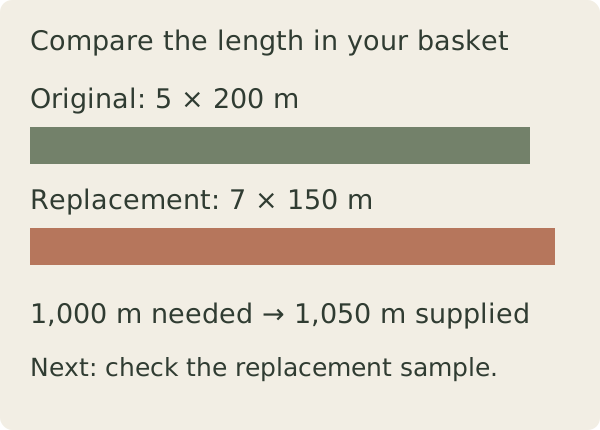
Do this separately for each color. If the pattern gives both estimated consumption and rounded purchase quantities, distinguish them in your notes. Do not silently add another allowance to a quantity that already includes one.
Let the sample make the decision
Use the intended stitch and follow the pattern’s gauge-measurement instructions. Record the hook size in millimeters. The Craft Yarn Council recommends making a gauge swatch and comparing it with the pattern; its guidance also explains adjusting hook size and sampling again when the gauge differs.
Check stitch gauge and row gauge, then handle the sample. Does it look and feel like the blanket you pictured? Prepare it according to the yarn’s care instructions as you intend to prepare the finished blanket, and note when you took the measurements. A matching stitch count alone does not answer every question about the fabric.
For an arithmetic illustration, a rectangular body with 160 stitches at 16 stitches per 10 cm is 100 cm wide. At 18 stitches per 10 cm, the same 160 stitches span about 88.9 cm. This assumes a uniform stitch gauge and excludes separate edge stitches and borders. A yarn substitution can therefore require a choice about size, even before you compare the amount used.
Keep the pattern size or deliberately resize
If you want the original dimensions, continue sampling until both the gauge and fabric meet your needs, or choose another candidate. If you prefer your replacement sample as it is, plan the new dimensions explicitly. Use the stitch-repeat calculator to check a compatible count, then consult the pattern for construction details; it cannot rewrite shaping or motif instructions.
For a uniform blanket body, use the replacement sample’s own dimensions and weight in the weighed-swatch estimate. Enter the replacement label’s grams and length. Carrying over the original yarn’s sample weight would mix two different measurements.
Finish with a complete buying note
Record the chosen yarn and color, accepted sample, planned body size, revised body estimate, allowance and separate finishing reserves. Add border yarn or joining yarn only once. Keep the details on your project sheet before rounding each color to whole packages. The examples here are original calculations; we have not physically tested a particular replacement pair.
Use the calculator ↗Examples illustrate the arithmetic; they are not physical project tests. Send a correction.