To choose a crochet blanket border color, start with three candidates: the main body color, a darker shade already in the blanket, and one small accent color. Compare them against the whole blanket, then crochet a short sample of your chosen edging. The best choice is the one that gives you the finish you want and leaves enough yarn to complete it.
You do not need a new palette for the border. A familiar shade can make the blanket feel complete; a different shade can be a deliberate final detail. For a gift, use what you know about the recipient's preferences rather than choosing colors from assumptions about age or gender.
Decide what you want the edge to do
In Edie Eckman's guide to choosing crochet borders, color placement and the final round are part of the overall design, alongside scale and yarn. Treat color as something to try on your actual fabric, not a rule that every blanket must follow.
| Direction to try | Start with | Question to ask |
|---|---|---|
| A quiet edge | The body background or a frequently used shade | Do I like how the body continues into the edge? |
| A distinct frame | A darker shade from the blanket | Does this outline feel balanced at the planned width? |
| A small finishing accent | A less-used color from the body | Do I want this shade to be more noticeable? |
Compare the same blanket with three frames
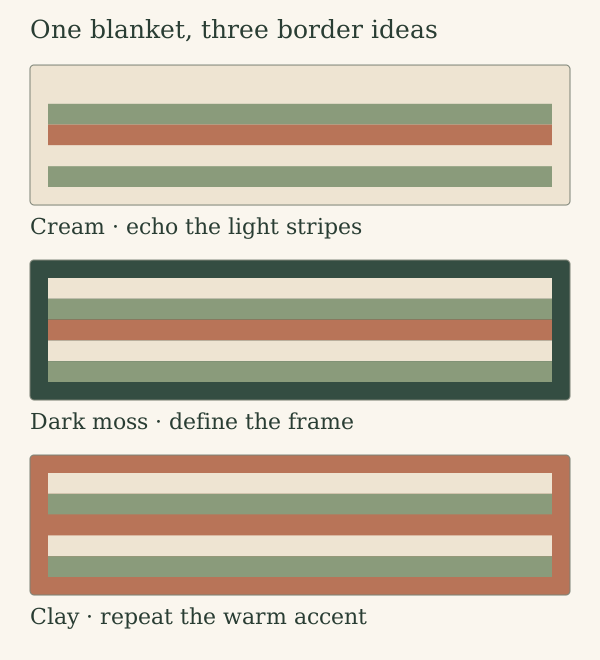
In this cream, moss and clay example, try cream when you want the edge to echo the light stripes, dark moss when you want a stronger outline, or clay when you want to repeat the warm accent. These are design suggestions, not promises about how your yarn will look. A glossy, fuzzy or variegated yarn can look quite different from a flat color block.
Lay the blanket out and place small bundles of each candidate beside both a light and a dark section. Look from your usual viewing distance, then close up. If you photograph the options, keep the light and camera position consistent. Screens and photographs help compare layouts but cannot replace seeing the yarn itself. Our color-contrast guide offers a separate check when adjacent shades are difficult to distinguish.
Try the actual border width and color order
A strand along the edge is a shortlist tool; it does not show a broad border. Work the intended edging on a representative sample, including a corner if the pattern permits. Follow the border pattern's stitch and corner instructions. This article chooses colors; it does not supply a universal edging pattern.
For a two-color border, make two notes: the shade next to the blanket body and the shade at the outer edge. Compare both orders if you are undecided. Keep the intended number of rounds beside each shade so you do not accidentally compare a narrow accent with a wide band.
Check the supply before falling in love with one option
Small leftovers can be enough for a sample without being enough for a full perimeter. Weigh each candidate separately and use your border sample to estimate the border's yarn requirement. Do not divide a multicolor border budget equally just because it has two colors; different rounds can use different amounts.
For an illustrative supply check, suppose your sample-based estimate for the selected shade is 70 g before an allowance. A chosen 10% allowance makes that 77 g. If you have 52 g available after other finishing reserves, the gap is 25 g. That percentage is a planning choice, not a tested guarantee. Choose a different shade, source compatible yarn, or sample a narrower design and recalculate before starting.
Keep the final color order, sample and reserve together. If you need more of an existing shade, check the dye lot; if you change yarn, check the new fabric and care requirements too. A color decision is finished only when the design and available supply agree.
Keep planning your blanket
Examples illustrate the arithmetic; they are not physical project tests. Send a correction.