To check a crochet blanket palette, compare the colors that will actually touch, then make a small sample in the intended stitch. A group of lovely yarn balls can look quite different once one shade becomes a narrow stripe or a square’s outer round. Choose whether you want a soft blend or a clearly defined pattern before deciding that a combination needs changing.
Decide what you want to stand out
For a quiet throw, you might enjoy gentle transitions. For a checkerboard or a repeating stripe, you may want each boundary to remain easy to see. Neither choice is automatically better. Start with the recipient’s preferences or the room where the blanket will live, rather than a rule about which colors belong together.
Our inspiration palettes suggest starting colors. This guide helps you test the boundaries within your chosen layout; it does not assign yarn quantities.
Check neighboring pairs, not just the collection
Write the color sequence on paper. For a repeating A–B–C stripe, check A beside B, B beside C and C beside A: the last pair meets when the sequence repeats. For squares, check the outer rounds against the joining yarn as well as the colors inside each square.
Lay the actual yarns side by side and compare them in the light where you expect to use the blanket. In its color-combination guide, Lion Brand recommends a sample in the actual stitch and a black-and-white photograph to help compare light and dark values. Treat the photograph as a supporting check: camera exposure and screen settings can change what you see.
Try a separator before replacing the palette
If two neighboring shades blend more than you want, try placing a light or dark separator between them. The illustration uses moss and clay with cream as a possible separator. These are screen colors, not matches to named yarns, and the arrangement is a design suggestion rather than a tested pattern.
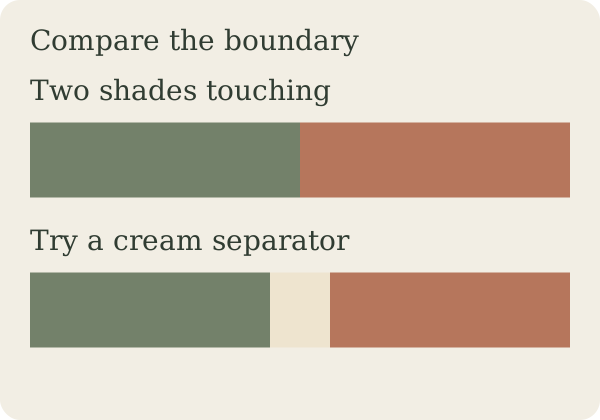
Keep the experiment small: change the separator or the order, then compare again. If you change the yarn, stitch and stripe width at once, it becomes harder to identify which change helped.
Sample the proportions you plan to use
For a hypothetical stripe plan of four moss rows, one cream row and four clay rows, test that nine-row arrangement rather than equal-sized blocks of all three. Include the return to the start of the repeat so you see the clay-to-moss boundary too. A separator inside the repeat does not automatically separate its ends.
If you want cream at both boundaries, a four-moss, one-cream, four-clay, one-cream repeat has ten rows. Six repeats would use 24 moss rows, 12 cream rows and 24 clay rows. Those are row counts, not percentages of yarn weight; make a separate budget for each color before adopting the change.
Keep the combination you enjoy making
View the sample close up and from the distance at which you normally see a throw. Check whether the joins, bands or motifs read as you intended. If the low-contrast version feels right, you do not need to increase contrast just to pass a photo check.
Record the chosen sequence and yarn identifiers on your project sheet. Check dye lots before buying more, and use the calculator below only to estimate length in identified partial balls. It cannot judge color relationships or predict the appearance of a finished blanket.
Keep planning your blanket
Examples illustrate the arithmetic; they are not physical project tests. Send a correction.