For a crochet blanket worked with two strands held together, budget both strands separately using a sample made with the actual combination. Do not simply double the yarn quantity from a single-strand blanket: the combined fabric can have a different gauge, so it needs its own measurements.
Choose the combination you want to see
A cream strand beside moss can suggest a softly mixed color; two matching strands can keep a more uniform palette. Make a sample before committing to either effect. Lion Brand’s multiple-strand guide explains that the strands are worked together as one in each stitch and that combining colors or textures changes the appearance.
Check that both yarns have compatible care instructions, especially for a gift, and record the hook, stitch and finished sample dimensions. A combination you enjoy looking at still needs to feel suitable for the blanket. Our mixed-yarn planning guide covers that selection step.
Read the pattern quantity before multiplying
If your pattern already uses yarn held double, find out whether its listed amount covers both strands together or specifies an amount for each. Do not double an already combined quantity. If the wording is unclear, ask the designer or publisher before buying yarn.
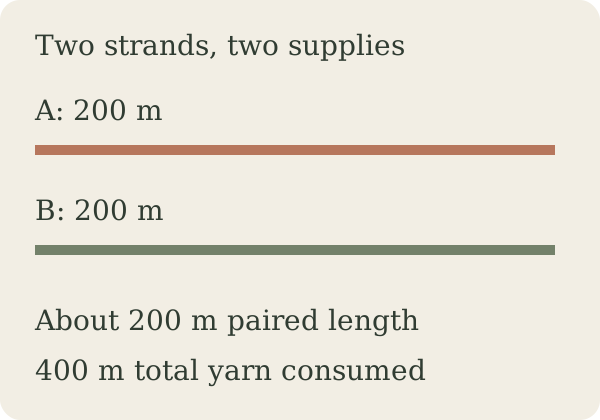
For an idealized length example, feeding two equal strands through 200 m of work consumes approximately 200 m from each supply: 400 m total. A single 400 m supply split into two equal feeds offers approximately 200 m of paired length. This explains the bookkeeping; it does not predict a blanket size or exact consumption.
Weigh each supply around the same sample
Weigh each source ball before and after making a representative sample, excluding labels and other objects. Record the weight decrease for yarn A and yarn B separately. Use a large enough sample for your scale to resolve each difference reliably. Measure the full sample area represented by those weights, rather than a smaller central gauge window.
Do not divide the combined sample weight equally when the strands are different yarns. Equal lengths can have different weights. If your sample uses yarn that will not remain available for the blanket, account for that consumption separately.
A separate budget for cream and moss
In this hypothetical example, a 10 × 10 cm sample consumes 3 g of yarn A and 2 g of yarn B. A 100 × 120 cm rectangular body is 120 times that area. Assuming the same fabric throughout, the base estimates are 360 g of A and 240 g of B.
| Supply | Body estimate | With 10% allowance |
|---|---|---|
| Yarn A | 360 g | 396 g |
| Yarn B | 240 g | 264 g |
The 10% is an illustrative planning choice, not a tested guarantee. If each yarn comes in 100 g packages, those body budgets round separately to four packages of A and three of B. Add any unavailable sample yarn and finishing requirements before making the final purchase calculation.
Let the shorter supply set the limit
Enough total grams is not enough if one strand runs out. Keep both budgets visible in your project notes. If you change one strand partway through for a color transition, sample that new pairing and budget its section separately.
Use the remaining-yarn calculator below on each individual yarn with its own label ratio. It converts weight to approximate length; it does not calculate the combined gauge. For edging, decide whether both strands continue or the border uses another combination, then make a separate border estimate. Reserve both supplies when the finish also uses both.
Use the calculator ↗Examples illustrate the arithmetic; they are not physical project tests. Send a correction.