To budget the yarn cost of a crochet blanket, estimate the amount needed for each color, subtract usable yarn you already own, round each remaining amount up to whole packages, and multiply by the price per package. Add delivery and other costs separately. A total in grams alone will not tell you what you will spend at checkout.
Start with quantities you can explain
Use your pattern's yarn requirement or an estimate from your own swatch. Write down whether that amount includes the border, joins, fringe and a contingency allowance. Add missing sections, but do not add them again if they are already included. Keep meters and yards separate until converted to the same unit.
The Craft Yarn Council's yarn-label guidance identifies package yardage, fiber content, care information and color or dye-lot details as useful label information. Use the actual label or current listing for the package you intend to buy, not the size of a ball from a different range.
Make one shopping line for each color
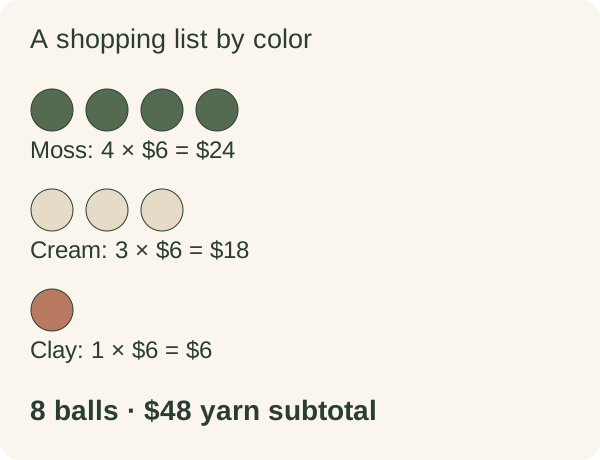
Here is a hypothetical three-color blanket budget. The required grams already include its planned finishing and allowance. All packages in this example contain 100 g and cost $6; these are invented arithmetic inputs, not current store prices. Existing yarn is assumed to be suitable for this particular project.
| Color | Required / owned | Buy / cost |
|---|---|---|
| Moss | 430 g / 80 g | 4 balls / $24 |
| Cream | 260 g / 0 g | 3 balls / $18 |
| Clay | 110 g / 30 g | 1 ball / $6 |
Moss needs 350 g more, so buy four 100 g balls. Cream needs three; clay needs one. That is eight balls and $48 for new yarn. Dividing the combined shortage of 690 g by 100 g and rounding once would suggest seven balls, but it would leave a shortage in one of the colors. Round each shade separately.
The purchase plus owned yarn gives 910 g against an 800 g requirement. The 110 g difference is package rounding, not another allowance you must automatically add. Actual leftovers depend on actual consumption. Keep shade balances separate on your color worksheet.
Compare package sizes without being misled
For an identical yarn sold in different package sizes, compare cost per meter or yard, then calculate the whole-package purchase. Suppose you need 1,200 m: a 200 m ball at $6 costs $3 per 100 m, while a 350 m ball at $9 costs about $2.57 per 100 m. You need six smaller balls or four larger ones. Both purchases cost $36; the larger packages supply 200 m extra. A lower unit price does not always lower the amount paid.
With different yarns, unit price is only a first comparison. The same length may produce different amounts of your chosen fabric. Check suitability and sample the replacement yarn before treating it as an equivalent. For a multicolor project, repeat the package calculation by shade.
Keep purchase cost separate from project value
Owned yarn can reduce today's cash outlay without making the blanket cost nothing. You may want two totals: new spending for this project, and the value of all materials used. This guide calculates the first. It is not a formula for pricing handmade work for sale, and it does not put a price on your time.
Below the yarn subtotal, list any pattern purchase, tools you actually need, delivery, applicable taxes and gift packaging. Check which charges are already included in the displayed price. If the final checkout exceeds your limit, decide what to change before ordering.
Adjust the plan while keeping what you love
Try a smaller size that still gives the coverage you want, a simpler finishing detail, or fewer accent colors. Each is an option, not a guaranteed saving: recalculate whole packages after the change. Removing a few rows may leave the shopping total unchanged if you still need the same number of balls.
Reserve the shades that make the design feel special, then compare alternatives for the larger areas. Check dye lots and available quantities before committing. Save the dated shopping list with your project notes, and replace the example prices here with the actual prices you see.
Keep planning your blanket
Examples illustrate the arithmetic; they are not physical project tests. Send a correction.