For a center-out blanket with a fixed yarn supply, reserve the finish first and check whether you can complete the next whole round or pattern repeat. Do not divide the remaining yarn by the average of the first few rounds: outer rounds cover more ground, and their stitch instructions may change.
Choose a finish that looks deliberate
Picture the outer edge before starting. A final moss band, a narrow cream frame or a complete color sequence can make the stopping point feel planned. Identify which rounds in your chosen pattern are suitable places to end and which require another round to complete the motif.
The Craft Yarn Council’s pattern-reading guide explains repeats and stitch counts. Follow your pattern’s round instructions and increases; this budgeting guide is not a new center-out pattern. If the design requires a fixed final sequence, budget that sequence together.
Keep the finishing reserve outside the body budget
Inventory the available yarn by color and subtract the amounts set aside for the intended border, ends and other finishing. Use your own sample or a pattern-specific quantity to establish the reserve. See the border yarn guide for that separate task.
In a hypothetical one-yarn plan, 180 g remains in the supply and 40 g is reserved for finishing. That leaves 140 g for more body rounds and their allowance. The reserve is already excluded; do not subtract it a second time later.
See why the later rounds need their own estimate
For a flat square, a band extending 2 cm beyond each edge of a 40 cm square covers 44² − 40² = 336 cm². The same-width band around an 80 cm square covers 84² − 80² = 656 cm². The second band has nearly twice the area, despite adding the same amount to each side.
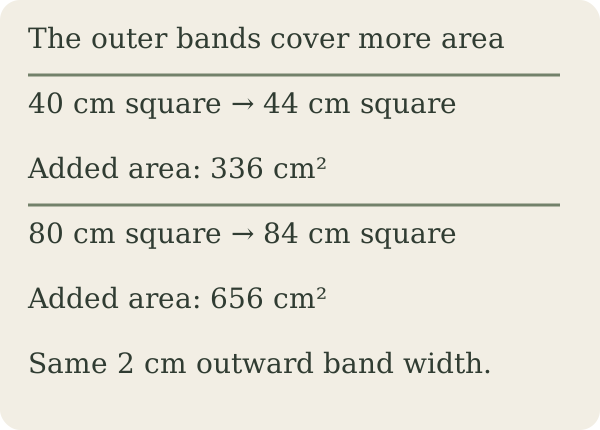
This geometry explains the growing budget; it does not establish grams per round. Texture, open spaces and changing stitches need their own measurements. Rectangles, circles and shaped motifs require their corresponding dimensions rather than this square calculation.
Measure a recent representative round
Weigh the supply before and after a complete round, keeping labels out of both readings. Record the consumption, color, stitch construction and pattern count. Use a scale that resolves the change reliably. If the next round uses the same construction, its count can help you make a provisional estimate.
For example, suppose a recent round consumed 12 g for 240 equivalent repeated units, and the next comparable round has 260 units. The estimate is 12 × 260 ÷ 240 = 13 g. An illustrative 10% allowance gives 14.3 g. This assumes comparable yarn use per unit, including how corners are handled; do not apply it to a new texture or differently composed round without another sample.
Decide before starting the next complete section
Compare that section’s estimate plus allowance against the body budget in its required color. With only 14 g available outside the finishing reserve, the example’s 14.3 g estimate does not fit. Stop at an earlier suitable boundary, revise the design using the pattern, or obtain more compatible yarn before continuing.
If the next complete color sequence contains several rounds, estimate each at its own size and add them. Enough total yarn does not ensure enough of the outer color. Keep separate entries using the color-budget approach, and check dye lots if adding supplies.
Use the calculator as a check, not a stopping instruction
The stash planner below estimates rectangular dimensions from a representative sample. It does not know your expanding round counts or legal pattern endpoints. Reweigh after each completed section, update the remaining budget and choose the next whole section only when its estimate fits. Record the final planned edge on your project sheet so the last round feels like part of the design.
Use the calculator ↗Examples illustrate the arithmetic; they are not physical project tests. Send a correction.